
What Is a Digital Third Space?
Philosophy · by Simone Rainieri · 11 min read · Published
A digital third space is an online environment that does the job pubs, cafes, churches, and barbershops used to do: a place beyond home and work where people show up regularly, informally, and without an agenda, and where relationships form as a byproduct of simply being there. The term borrows from sociologist Ray Oldenburg, who called those physical places third places and argued they were where community actually lived. The digital version is not a metaphor and not a marketing label, or at least it should not be. It is a specific claim: that some of the social functions of a disappearing physical institution can be rebuilt in software, and a specific admission: that some of them cannot.
This piece takes the claim seriously in both directions. What third places were, what the numbers say about their decline, what a digital space has to do to earn the name, and where the substitution honestly breaks down.
Where the idea comes from
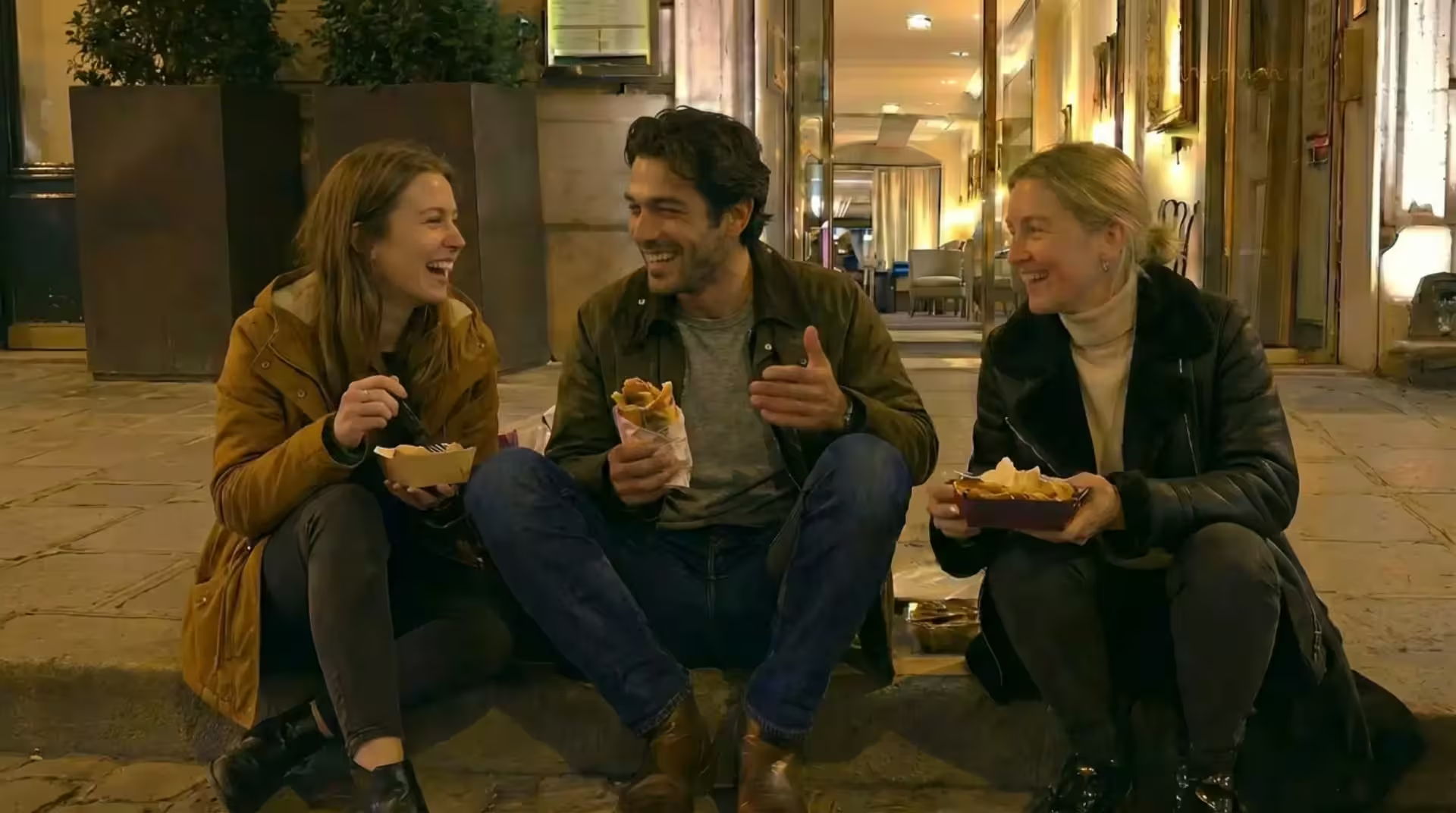
Oldenburg introduced the concept in his 1989 book The Great Good Place. His definition was precise: a generic designation for the great variety of public places that host the regular, voluntary, informal, and happily anticipated gatherings of individuals beyond the realms of home and work (Project for Public Spaces). Home is the first place, work the second. The third is the tavern, the coffee house, the beauty salon, the corner store with chairs in it.
What made his account more than nostalgia was the feature list. Third places, he argued, share a recognizable anatomy. Conversation is the main activity, whatever the nominal excuse. Entry is cheap or free, with no barriers of membership or status. Regulars set the tone and welcome newcomers. Status from outside does not transfer; the barrister and the plumber hold equal rank at the bar. The mood is playful. And the place functions as a home away from home, somewhere you can arrive alone and not be alone.
Notice what is missing from that list: any mention of walls. Oldenburg was describing physical places because in 1989 there was no other kind, but the anatomy is social, not architectural. That gap is exactly where the digital question enters.
The decline is real and measurable
The reason anyone is asking whether software can host community is that the physical hosts are closing. The numbers here are not vibes. Gallup has tracked American religious membership for eight decades: 69 percent of Americans belonged to a church, synagogue, or mosque in 1998 to 2000. By 2020 membership had fallen below half for the first time in the poll's history, to 47 percent (Gallup). Whatever you think of religion, congregations were the largest third-place network in the country, and no secular institution has absorbed the people who left.
Britain is losing its equivalent institution at a steady bleed. In 2025, an average of one pub a day closed in England and Wales, with 366 demolished or converted over the year, part of a long fall from tens of thousands more a generation ago. And survey data suggests the loss is felt at the individual level: the Survey Center on American Life, run by Daniel Cox at AEI, found that 59 percent of Americans report having a third place they visit regularly, down from 71 percent in 2019 (AEI). Twelve points in five years is a fast slide for something civilizational.
The same survey found a third of people without a regular local spot have no diverse social connections at all. Third places were never just pleasant. They were where people met the friends they did not choose in advance, the ones from outside their job, their age band, their politics.
Why the decline? Rents and property values converted pubs into flats. Remote work removed the commute that threaded people past the coffee shop. Suburban design zoned gathering out of walking distance decades ago. And the marginal evening at home got dramatically better: the couch now offers infinite entertainment, which the pub must beat just to get you through the door. No villain, just a hundred small optimizations, each reasonable, summing to a society with fewer rooms to be casually together in.
What a digital third space actually is
Run Oldenburg's anatomy against the internet and most of it fails immediately. A social media feed is not a third place: there are no regulars, no shared room, no equality of status, and the main activity is broadcasting, not conversation. An algorithmic feed is closer to television with comments. But some corners of the internet pass surprisingly well. The long-running Discord server where the same forty people drift in and out nightly. The small subreddit where regulars know each other's histories. The group that met in an online game a decade ago and still gathers every Thursday. These have regulars, levelers, playful moods, and conversation as the point. People describe logging in the way Oldenburg's subjects described stopping at the tavern: not for anything, just to be there.
So the honest definition has teeth. A digital third space is an online environment with persistent membership, a manageable scale where individuals are recognizable, conversation as the core activity, low barriers to entry, and norms set by the people present rather than by an engagement algorithm. Persistence is the load-bearing wall. A third place is somewhere you return to, where being known accumulates. Anything built around infinite strangers, random video roulette being the purest case, is the opposite of a third place no matter how social it feels for a minute, a distinction we drew in our guide to video chat apps for meeting new people.
Scale deserves its own sentence. Every real third place, physical or digital, is small. The pub works because the room holds forty people and the same ten are always there. Platforms fail at community precisely as they succeed at growth, because recognition does not scale.
The unbundling: what moved where
What actually happened to the third place is less a death than an unbundling. The old pub bundled several services in one room: ambient company, scheduled anticipation, chance encounters with strangers, a stage for regular low-stakes conversation, and somewhere to bring a new acquaintance. The internet took the bundle apart. Ambient company went to Discord voice channels and body-doubling apps. Scheduled anticipation went to the group chat and the weekly game night. The stage for casual talk went to a hundred small communities. Each fragment works. What got lost in the unbundling is the chance encounter, the person you did not select. Online, nearly everything is chosen, and choice filters out exactly the accidental variety that made third places socially nutritious.
That is the piece worth deliberately rebuilding, and it is the part of the third-place tradition Vairi tries to carry: an introduction to one person you did not pick from a grid, chosen instead for how your conflict styles and life chapters fit, met anonymously first the way you would meet a stranger at the bar rather than through a resume of photos. Then the digital equivalents of doing something side by side, watching a film in sync, playing a prompt game, sitting on a call. Whether that fully earns the third-place label is genuinely arguable. What it borrows from Oldenburg is the specific thing feeds abandoned: the unchosen encounter, given a room to happen in.
What digital versions honestly cannot do
A fair account has to name the losses, and they are not small. Physical co-presence carries information and comfort no protocol replicates: the regulars notice you looked tired before you say anything. Third places served the whole neighborhood, including the elderly and the offline, while digital spaces select for the digitally fluent. The pub imposed a body and a name on your behavior; anonymity, whatever its uses, weakens the accountability that kept third-place banter civil. And a screen at home does not get you out of the house, which for many lonely people is half the problem.
There is also the commercial hazard. Oldenburg's places were indifferent to your attention; the publican wanted you happy, not engaged. Most digital spaces are owned by someone optimizing something, and the moment the optimization target is time-on-app rather than the health of the room, the space stops being a third place and becomes a casino with chairs. Any digital third space worth the name has to be structurally boring about engagement: it should want your Tuesday evening, not your every waking scroll, and it should count success by what happens between two people, not by minutes logged.
So the sober conclusion is substitution with remainder. Digital spaces can host the conversational and relational functions of the third place, sometimes better than physical ones can for the shy, the new-in-town, and the scattered, a case we made in one-to-one apps versus group events. They cannot host the bodily, neighborhood, and civic functions. A society that replaces every pub with a server has still lost something, even if every server is good.
How to use one well
Treat a digital third space the way a regular treats a local. Go often rather than long; twenty minutes nightly builds recognition faster than a monthly binge. Be a regular, which means being recognizable, consistent, and mildly generous with attention. Bring conversation rather than content. And let the space do what third places always did best, which is turn ambient familiarity into particular friendship: when one person in the room becomes someone you would miss, take that thread into its own space, whether that is a direct chat, a call, or eventually a first hangout in the physical world.
The physical decline is not reversing soon. Church membership did not bounce back after 2020, and converted pubs do not reconvert. The realistic project is not mourning the great good places but building rooms, on whatever substrate, that pass Oldenburg's checklist: regulars, conversation, low doors, level floors, playful air. Where those hold, the label is earned.
Did the internet kill the third place, and can it repay the debt?
There is an obvious objection to this whole project: asking the internet to host third places is asking the arsonist to rebuild the house. The timing is at least suggestive, since the steepest drops in third-place attendance track the smartphone decade. But the honest reading of the evidence is messier. Pub closures track property economics and drinking habits as much as screens. Church decline began before the web and follows generational belief change, visible in Gallup's numbers as a rising share of Americans with no religious preference at all. The couch did not defeat the pub because the couch had wifi; it won because the pub got expensive, the commute disappeared, and the neighborhood emptied during the day.
So the fairer verdict is that the internet accelerated a decline it did not start, and that it did so with its worst products, the infinite feeds, rather than its best ones, the small persistent rooms. Which means the debt is repayable in kind: not by building bigger platforms, but by building more rooms. The test for any of them is the one this piece keeps returning to. Would a regular be missed if they stopped coming? In a feed, never. In a real third place, digital or brick, always.
Key takeaways
Oldenburg's third place has a checkable anatomy: regular, voluntary, informal gathering beyond home and work, with conversation central and outside status left at the door. The decline is measured, not felt: US church membership fell from 69 to 47 percent between 2000 and 2020, England and Wales lost a pub a day in 2025, and Americans with a regular third place dropped from 71 to 59 percent since 2019. A digital space earns the name only with persistence, recognizable regulars, and human-set norms; infinite-stranger feeds and roulette apps fail the test by design. Digital third spaces can carry conversation and connection but not bodies, neighborhoods, or the unplanned civic mixing, so use them to produce particular friendships, not to replace the world.
Related reading: Where to meet new friends when it feels like there is nowhere left, Can watching a movie with a stranger online actually make you friends?, Icebreaker games to play online with someone new
Read next: Can Watching a Movie With a Stranger Make You Friends?
Meet people from your city, from your sofa.
Friday Aperitivo is one relaxed hour online with a few new people, every Friday at 8pm UK time. Tables of up to six, voice with camera optional, and Vairi hosts with question cards. Free.
Proudly listed on Launchpadly Startup Directory