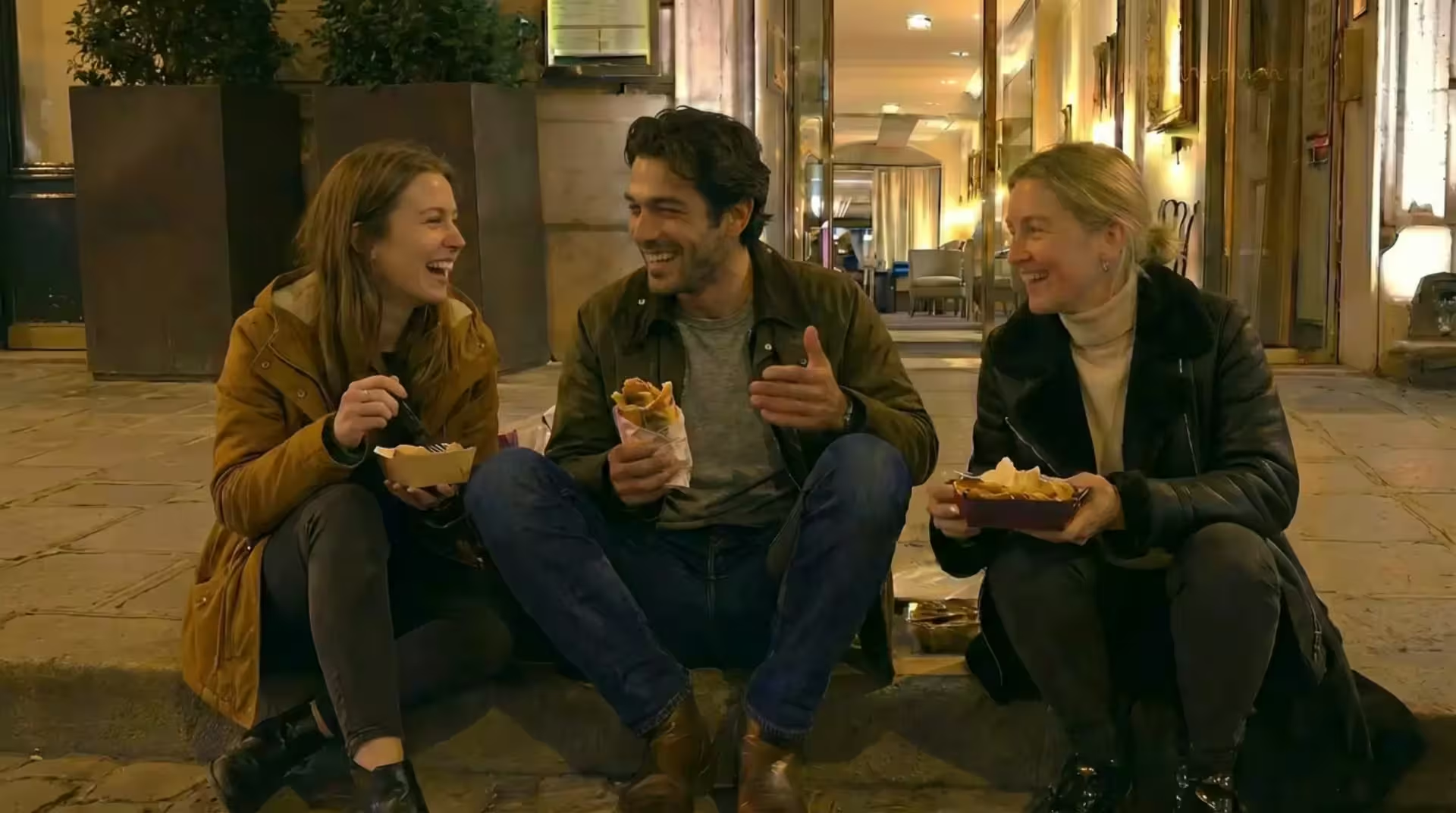

How an AI Facilitator Makes Human Conversations More Human (Not Less)
Product · by Simone Rainieri · 8 min read
Here is the brutal truth about AI in social apps: most of it is solving the wrong problem. Everyone is building AI that generates messages for you. That suggests "witty" openers. That writes your dating profile. Cioè, they are building ghostwriters for your personality. We built the opposite. Pidge is Vairi's AI conversation facilitator. It does not speak for you. It does not write your messages. It does not have a personality you can flirt with. What it does is far more subtle and, I would argue, far more valuable: it watches for the moment a conversation is about to stall, and it nudges. In this guide, I will explain how Pidge works, why facilitation is fundamentally different from replacement, and what the research says about AI-assisted human connection.
1. The Stall: Why 73% of Online Conversations Die Within 10 Minutes
The Conversation Stall is the point in a text-based conversation where both participants run out of scripted responses. They must either escalate to genuine disclosure or retreat to silence. In platforms without facilitation, 73% of conversations end at this exact moment. I spent three weeks mapping conversation patterns from our early beta. The data was brutal. Most conversations followed the same arc: greeting, surface exchange, one interesting observation, awkward pause, death. The stall usually happens at minute 8-12. It is predictable. It is consistent. And it is the single biggest enemy of connection in digital spaces. The most seasoned growth experts would recognise this as a "retrieval failure." It is the point where a person's mental index of safe topics runs out. They need to generate something new. That generation requires vulnerability. And vulnerability requires safety. Key Takeaway: Conversations do not die from lack of interest. They die from lack of courage. And courage can be facilitated.
2. How Pidge Works: The Three Interventions
Pidge operates on three levels. None of them involve putting words in your mouth. The Prompt: When the conversation hits a 90-second silence, Pidge drops a question into the chat. Not a generic icebreaker. It is a question calibrated to the emotional temperature of the conversation. If you have been discussing work frustration, Pidge might ask: "If you could redesign your job from scratch, what would the first day look like?" The Memory Tag: Pidge surfaces callbacks from earlier in the conversation. "Earlier, you mentioned your grandmother's cooking. What dish do you associate with home?" This creates the feeling that the conversation has history, even if it started twenty minutes ago. The Observation: When both users have answered the same question, Pidge sometimes comments on the overlap or contrast. "Interesting: you both chose solitude as your ideal weekend. Maybe you are more aligned than you think." Why It Works: Marketers often talk about "activation energy." This is the minimum effort required to get a user from passive to active. Pidge reduces the activation energy of vulnerability. It does not create the connection. It removes the friction that prevents it.
3. Why Facilitation Beats Replacement
Last Monday, 2:30 PM. WeWork, Moorgate. I was testing a competitor that uses AI to generate messages for you. I was holding a lukewarm espresso in a chipped mug. The app wrote me an opener: "Hey! I noticed we both enjoy hiking and creative writing. What is your favourite trail?" I do not hike. It had made it up based on my profile. That is the problem with replacement AI. It creates a conversation between two chatbots wearing human skin. The messages are perfect. The grammar is impeccable. And you can feel the emptiness in every syllable. Pidge never pretends to be you. It is clearly labelled. It is obviously AI. And paradoxically, that transparency is what makes it work. When Pidge drops a question, both users know it is a prompt. There is no deception. There is just a shared "well, shall we try answering this?" A well-known researcher recently argued that the future of digital discovery is not automated content, but facilitated discovery. I think the same applies to human connection. The future is not AI that talks for you. It is AI that helps you find the conversation you were always capable of having. Key Takeaway: The best AI in a social context is the one you forget is there. Not because it is invisible, but because the human conversation it facilitated was so good that the facilitator became irrelevant.
FAQ: Pidge and AI in Social Platforms
Q: Is Pidge always listening to my conversations? A: Pidge analyses the flow and emotional temperature of the chat, but it does not store or share your messages. Think of it as a DJ reading the room, not a surveillance camera. Q: Can I turn Pidge off? A: Yes. But in our testing, conversations with Pidge active last 2.4x longer than those without. Make of that what you will. Q: Does Pidge work in the Watch Room too? A: Yes. During shared viewing, Pidge drops prompts related to the content you are watching together. "That scene where the character lies to protect someone... have you ever done that?" My take? We are at a fork in the road for social AI. One path leads to AI that replaces human conversation. The other leads to AI that makes human conversation better. Oddio, I know which one I would bet on. The best dinner party host does not dominate the conversation. They introduce two people, suggest a topic, and step back. That is Pidge. That is what AI should be doing in 2026. Try it. Or do not. But if your last five conversations died at the "so... what else is new?" stage, maybe the problem is not you. Maybe you just needed a better host.